Microplastics, Microbes, and How Plastic Particles Become Living Ecosystems
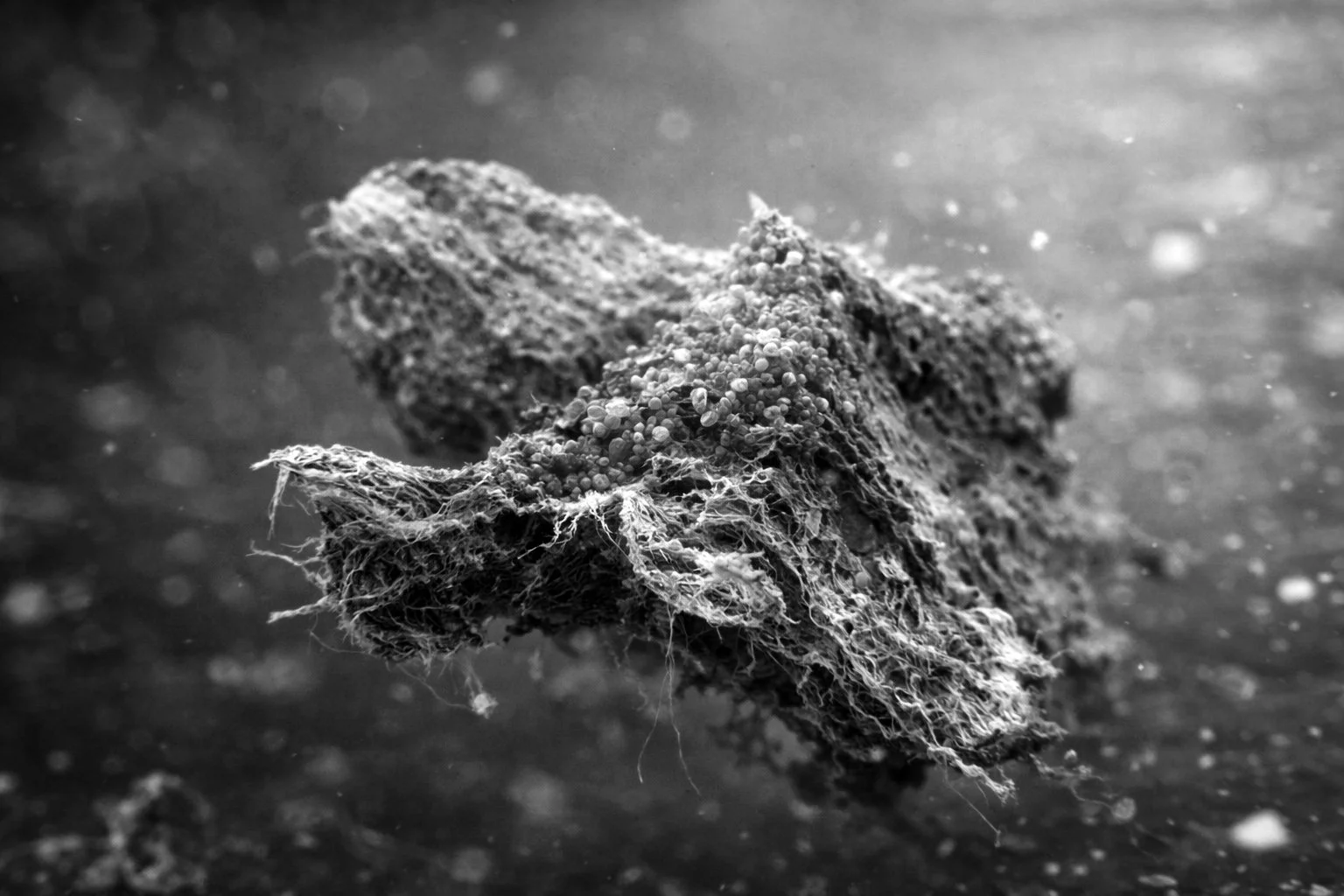
Microplastics are often discussed in the context of environmental pollution, marine life, and human exposure. Less frequently examined is their biological dimension. Once plastic fragments enter aquatic or terrestrial environments, they do not remain chemically and biologically inert. Instead, they can become colonised by complex microbial communities.
Over the past decade, researchers have begun to describe what is now referred to as the “plastisphere”, a term used to describe the microbial ecosystems that form on plastic debris. These communities differ from surrounding environmental microbiota and may exhibit unique ecological characteristics.
Understanding how microplastics and microbes interact does not automatically imply elevated health risk. However, it does reveal that plastic particles participate in environmental biological systems in ways that were not widely considered when polymer materials were first developed.
What Are Microplastics?
Microplastics are generally defined as plastic particles smaller than five millimetres in diameter. They can be broadly categorised into two types.
Primary microplastics are manufactured at small sizes. These include microbeads once used in cosmetic formulations and industrial abrasives, as well as synthetic microfibres released from textiles.
Secondary microplastics arise from the fragmentation of larger plastic items through mechanical wear, ultraviolet radiation, oxidation, and environmental degradation. Tyre wear particles, degraded packaging, and weathered construction materials all contribute to secondary microplastic generation.
Because plastics are lightweight, durable, and resistant to biodegradation, microplastic particles can persist in marine, freshwater, and soil environments for extended periods. Their high surface-area-to-volume ratio and relatively stable polymer backbone create a physical substrate upon which microorganisms can attach.
Do Microplastics Attract Microorganisms?
Yes. Research consistently shows that once plastic particles enter natural environments, they are rapidly colonised by microorganisms.
Microbial colonisation typically follows a predictable sequence. Within hours to days of environmental exposure, organic molecules form a conditioning film on the plastic surface. This thin layer alters surface chemistry and creates favourable conditions for microbial adhesion. Bacteria, algae, fungi, and other microorganisms then attach and begin producing extracellular polymeric substances (EPS), forming structured biofilms.
The term “plastisphere” was introduced in 2013 in a study published in Environmental Science & Technology, which described distinct microbial communities on marine plastic debris compared to surrounding seawater. Subsequent research across oceans, rivers, wastewater systems, and soils has reinforced the observation that plastic surfaces host complex and often stable microbial assemblages.
Plastics do not actively “attract” microbes in a biological sense. Rather, they provide a durable, hydrophobic, and mobile surface within environments that already contain microbial life. In this context, plastic behaves as an artificial ecological niche.
What Is the Plastisphere?
The plastisphere refers to the diverse microbial ecosystems that develop on plastic surfaces in environmental settings. These communities may include bacteria, cyanobacteria, algae, fungi, protozoa, and small invertebrates.
Importantly, plastisphere communities often differ from adjacent environmental microbial populations. Several studies have shown that certain taxa preferentially colonise plastic surfaces. Factors influencing colonisation include polymer type, surface roughness, environmental conditions, nutrient availability, and the age of the plastic fragment.
Biofilms forming on plastics can be structurally complex. Within these biofilms, microorganisms are embedded in a matrix of polysaccharides, proteins, and extracellular DNA. This matrix provides mechanical stability and protection from environmental stressors such as UV radiation and predation.
Plastic fragments therefore become floating or suspended microhabitats. In marine systems, they may travel long distances, potentially transporting attached microbial communities across geographic regions.
It is important to note that most microorganisms identified in plastisphere studies are environmental species rather than human pathogens. Nonetheless, the ecological implications of mobile microbial habitats are an area of ongoing investigation.
How Do Polymer Properties Influence Microbial Colonisation?
From a material science perspective, plastic surfaces are not uniform. Polymer chemistry, additives, ageing processes, and mechanical degradation all influence surface properties.
Hydrophobic polymers such as polyethylene and polypropylene tend to accumulate organic molecules from surrounding water, creating conditioning films that facilitate microbial attachment. Surface oxidation during environmental ageing can alter surface energy and increase roughness, potentially enhancing adhesion.
Fragmentation increases total surface area. As macroplastics break down into microplastics and nanoplastics, the available colonisable surface expands dramatically. Smaller particles also remain suspended in water columns for longer periods, increasing exposure to microbial populations.
Additives within plastics may also influence colonisation dynamics indirectly. Stabilizers, plasticisers, and fillers can migrate to surfaces or leach into surrounding media, potentially altering local chemistry. However, the ecological relevance of additive migration in relation to microbial colonisation remains under study.
Overall, plastic materials provide persistent substrates in environments where natural surfaces may degrade more rapidly.
Can Microplastics Transport Pathogens?
One of the most frequently asked questions is whether microplastics can carry pathogenic microorganisms.
Several studies have detected potentially pathogenic bacteria within plastisphere communities. For example, certain Vibrio species, some of which are associated with marine infections, have been identified on marine plastic debris. Other studies have reported opportunistic pathogens in wastewater-associated microplastics.
However, the presence of a microorganism on plastic does not automatically indicate increased infection risk. Many environmental bacteria can be opportunistic under specific conditions without posing widespread public health threats.
Context is critical. Microplastics are present in environments already containing diverse microbial communities. Plastics may provide an additional surface for attachment, but they do not necessarily create pathogens where none existed.
Risk assessment in this area remains complex and is still evolving. Current research does not support the conclusion that microplastics are a dominant or primary vector for human disease transmission. Instead, they represent one of many environmental surfaces capable of hosting microbial life.
Microplastics and Antimicrobial Resistance
The intersection between microplastics and antimicrobial resistance (AMR) has drawn increasing scientific interest.
Biofilms, regardless of substrate, create dense microbial communities in close proximity. Within these environments, horizontal gene transfer can occur through mechanisms such as conjugation, transformation, and transduction. This proximity can facilitate the exchange of genetic material, including antimicrobial resistance genes.
Several studies have reported the detection of resistance genes within plastisphere biofilms, particularly in wastewater and river environments influenced by human activity. The hypothesis is that plastic surfaces may serve as aggregation points where bacteria carrying resistance genes interact and potentially exchange genetic material.
However, caution is necessary when interpreting these findings. Resistance genes are widespread in many environmental microbial communities, especially in areas affected by agricultural runoff, wastewater discharge, or pharmaceutical residues. Microplastics may be present within these same environments but are not necessarily the root cause of resistance development.
Current evidence suggests that plastic-associated biofilms can host resistant bacteria and resistance genes, but the magnitude of their contribution to global AMR dynamics remains uncertain. AMR is driven primarily by antimicrobial use and selection pressure. Microplastics may represent an ecological niche within this broader system, rather than a primary driver.
Ongoing research is focused on quantifying this relationship more precisely.
Microplastics in Wastewater and Treatment Systems
Wastewater treatment plants are significant points of intersection between microplastics and microbial communities. Microplastics enter treatment systems via domestic washing of synthetic textiles, industrial discharge, and surface runoff.
Within treatment plants, microplastics can become incorporated into activated sludge systems, where dense microbial communities already exist. Some studies have found higher concentrations of resistance genes in microplastic-associated biofilms within these systems.
Advanced treatment processes can remove substantial proportions of microplastics from effluent. However, captured microplastics may accumulate in sewage sludge, which in some regions is applied to agricultural land. This introduces additional complexity regarding soil microbiomes and environmental exposure.
Again, plastics are part of a multifactorial system involving antibiotics, heavy metals, nutrient loads, and microbial ecology. Their presence may influence local interactions, but they operate within a broader environmental framework.
Terrestrial Microplastics and Soil Microbiomes
While marine environments receive significant attention, soils may contain even higher concentrations of microplastics. Agricultural mulching films, sewage sludge application, tyre wear deposition, and atmospheric fallout all contribute.
Soil ecosystems are microbiologically rich and complex. Early research suggests that microplastics can influence soil structure, water retention, and microbial community composition. Biofilms also form on plastic fragments in terrestrial settings.
The implications for resistance gene exchange, plant-microbe interactions, and nutrient cycling are active areas of study. At present, conclusions remain preliminary, and long-term ecological impacts are still being investigated.
Mobility and Environmental Transport
One distinctive feature of microplastics is mobility. In marine systems, buoyant polymers can travel across ocean currents. Biofilm-covered plastic fragments have been detected far from their likely origin points.
This raises theoretical concerns regarding the transport of microbial communities across ecosystems. Invasive species, including microorganisms, may potentially disperse via plastic debris. However, the extent to which plastic-mediated transport significantly alters microbial biogeography is not fully established.
Microplastics may function as vectors in some contexts, but they are one of many floating or suspended substrates in aquatic systems, including natural organic matter and sediments.
Implications for Material Design and Waste Management
Understanding plastisphere formation does not necessarily indict plastic as uniquely hazardous. Rather, it highlights the ecological persistence of durable materials in natural systems.
From a material innovation perspective, several themes emerge.
First, durability and fragmentation matter. Reducing fragmentation rates may limit the generation of high-surface-area microplastic particles. Second, waste management infrastructure plays a critical role in preventing environmental release. Third, wastewater treatment optimisation can reduce microplastic discharge into aquatic environments.
Material selection, design for longevity, and responsible end-of-life management intersect with broader environmental microbiology considerations.
This systems-based perspective avoids simplistic narratives. Plastics offer significant societal benefits in healthcare, food safety, transportation, and infrastructure. The challenge lies not in eliminating materials wholesale but in understanding and managing their lifecycle impacts.
A Balanced Perspective
Microplastics are not biologically inert once released into the environment. They can host microbial communities, participate in ecological systems, and interact with biofilms in ways that researchers are only beginning to fully understand.
However, the presence of microbes on plastic does not automatically translate to elevated human health risk. Nor does it imply that plastics are a primary driver of antimicrobial resistance.
The relationship between microplastics and microbes is best understood as an ecological interaction within broader environmental systems. Continued research will refine understanding of how material properties, environmental conditions, and microbial behaviour intersect.
As with many complex environmental issues, nuance is essential. Plastic materials have enabled enormous advances in medicine, food preservation, and public health. At the same time, their environmental persistence creates new ecological contexts.
Recognising that microplastics can become living ecosystems is not a call for alarm. It is a reminder that materials, once released into natural systems, participate in biological processes.
Understanding those processes is a necessary step toward more informed design, responsible waste management, and resilient environmental systems.
Frequently Asked Questions
-
Yes. Research shows that microplastics can become colonised by bacteria and other microorganisms once they enter environmental systems. These microbial communities are referred to as the plastisphere.
-
Most microorganisms found on microplastics are environmental species. While some studies have detected potentially pathogenic bacteria, current evidence does not indicate that microplastics are a dominant source of infectious disease.
-
The plastisphere describes the microbial ecosystems that develop on plastic debris in marine, freshwater, and soil environments. These biofilm communities can differ from surrounding environmental microbiota.
-
Some studies have detected antimicrobial resistance genes in microplastic-associated biofilms, particularly in wastewater environments. However, AMR is primarily driven by antimicrobial use. The contribution of microplastics to global resistance spread remains under investigation.
References and Further Reading
Zettler, E.R., Mincer, T.J. & Amaral-Zettler, L.A. (2013). Life in the “plastisphere”: microbial communities on plastic marine debris. Environmental Science & Technology, 47(13), 7137–7146. https://doi.org/10.1021/es401288x
Arias-Andres, M. et al. (2018). Microplastic pollution increases gene exchange in aquatic ecosystems. Environmental Pollution, 237, 253–261. https://doi.org/10.1016/j.envpol.2018.02.058
Yang, Y. et al. (2019). Microplastics in municipal wastewater treatment plants: detection, removal and fate. Water Research, 152, 21–37. https://doi.org/10.1016/j.watres.2018.12.050
Li, X. et al. (2021). Microplastics as vectors of antibiotic resistance genes in aquatic environments. Water Research, 202, 117453. https://doi.org/10.1016/j.watres.2021.117453
Kirstein, I.V. et al. (2016). Dangerous hitchhikers? Evidence for potentially pathogenic Vibrio species on microplastic particles. Marine Environmental Research, 120, 1–8. https://doi.org/10.1016/j.marenvres.2016.07.004
Rummel, C.D. et al. (2017). Plastic ingestion by pelagic and demersal fish from the North Sea and Baltic Sea. Marine Pollution Bulletin, 102(1), 134–141. https://doi.org/10.1016/j.marpolbul.2015.11.043
World Health Organization (2019). Microplastics in drinking-water. Geneva: WHO. https://www.who.int/publications/i/item/9789241516198
World Health Organization (2023). Antimicrobial Resistance Fact Sheet. https://www.who.int/news-room/fact-sheets/detail/antimicrobial-resistance