Why We Need to Rethink Material Durability in a Microbial World
When engineers and material scientists discuss durability, the conversation typically focuses on a familiar set of challenges. Mechanical wear, chemical exposure, ultraviolet radiation, temperature fluctuations, corrosion, and fatigue have long been recognised as the primary forces that determine how materials perform over time. These degradation mechanisms are well understood, supported by decades of research, and embedded within the testing standards that guide material selection across countless industries.
Yet despite this sophisticated understanding of material performance, there remains an important factor that is often overlooked. Every material, regardless of its composition or intended application, exists within a biologically active environment. From the moment a product enters service, its surfaces begin interacting with a vast and complex ecosystem of microorganisms that are present in the air, water, on human skin, and throughout the built environment. These interactions occur continuously and, in many cases, persist throughout the entire lifecycle of the material.
Traditionally, microorganisms have been viewed primarily through the lens of hygiene and contamination. Their presence is associated with cleanliness, infection control, food safety, and public health. However, a growing body of scientific evidence suggests that microorganisms may also play a more significant role in material performance than is commonly recognised. Through processes such as surface colonisation, biofilm formation, metabolic activity, and the production of chemical by-products, microbial communities can actively modify the environment at the material surface and contribute to long-term degradation processes. This raises an important question: have we been thinking about durability too narrowly?
Materials Don't Exist in Sterile Environments
One of the limitations of traditional durability models is that they often evaluate materials under highly controlled conditions. Mechanical testing, thermal analysis, chemical resistance studies, and accelerated ageing protocols all provide valuable data, but they can struggle to replicate the complexity of real-world environments. In reality, materials do not exist in isolation. They exist within homes, hospitals, transport systems, workplaces, public spaces, industrial facilities, and consumer environments where biological activity is a constant presence.
Every surface is exposed to microorganisms through human contact, airborne particles, water, food residues, and environmental transfer. A bathroom surface may experience repeated exposure to moisture and organic matter. A train handrail may be touched by thousands of people each day. A reusable packaging container may be exposed to food residues, fluctuating temperatures, and repeated cleaning cycles. In each case, microbial deposition is not an occasional event but a continuous process.
This perspective fundamentally changes how we think about material exposure. While we routinely account for environmental factors such as heat, humidity, and ultraviolet radiation, biological exposure is often treated as a separate hygiene issue rather than a durability consideration. Yet microorganisms are every bit as much a part of the operating environment as temperature, moisture, or chemical exposure. If durability is intended to describe how a material performs under real-world conditions, then biological interaction deserves a place within that discussion.
The Hidden Process Happening on Material Surfaces
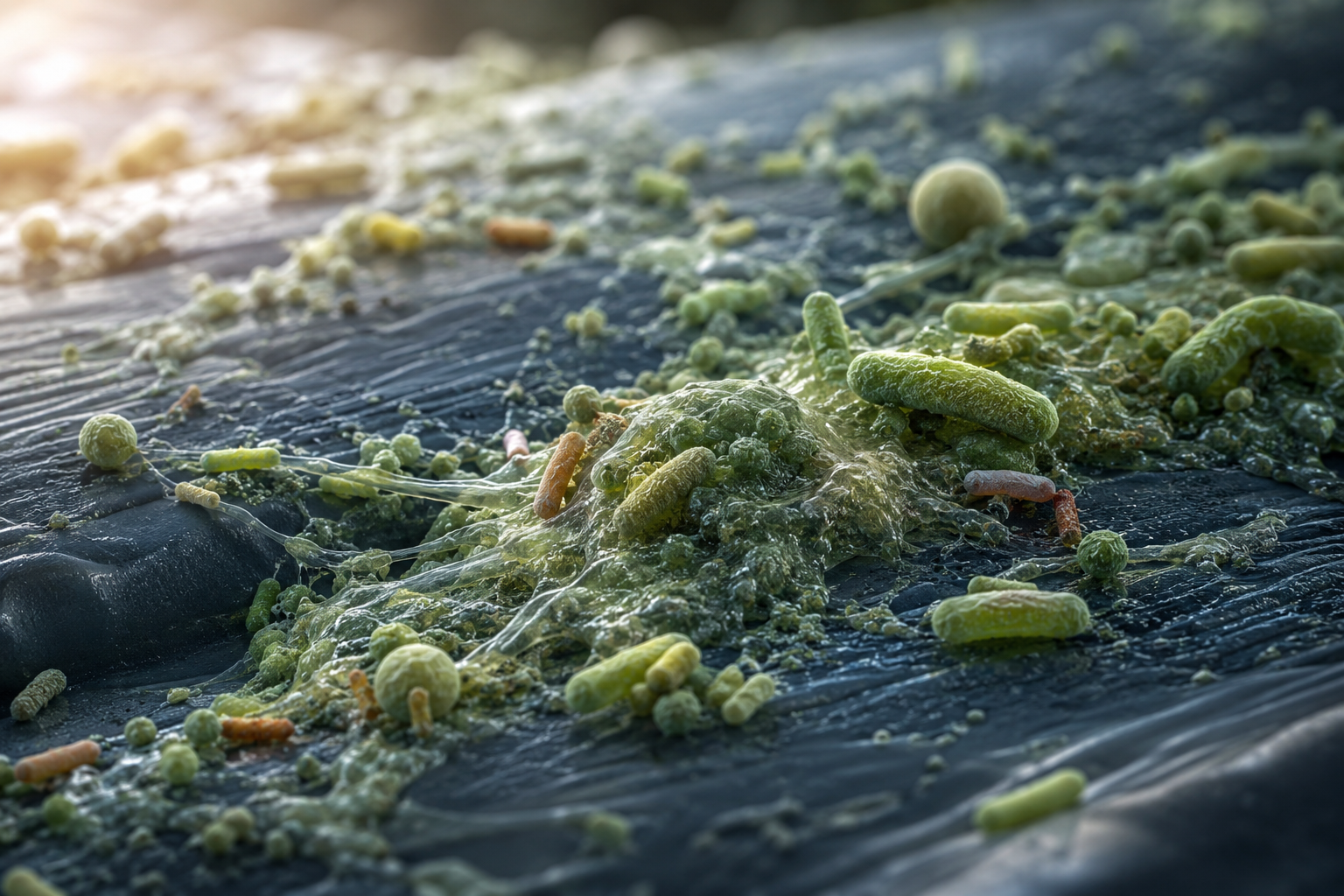
When microorganisms encounter a material surface, they do not simply remain dormant. Many species are capable of attaching themselves through a combination of physical and chemical interactions. Surface roughness, chemistry, moisture availability, and environmental conditions can all influence the likelihood of attachment. Once established, microorganisms often begin producing extracellular substances that help anchor them to the surface and support the formation of structured microbial communities known as biofilms.
Biofilms are among the most successful survival strategies in nature. Rather than existing as isolated cells, microorganisms within a biofilm function as a coordinated community protected by a self-produced matrix. This matrix helps retain moisture, concentrate nutrients, and shield microorganisms from environmental stress. As a result, biofilms can persist on surfaces for extended periods and often prove remarkably resilient.
The significance of biofilms extends beyond microbial survival. These communities actively modify the local environment at the material interface. As microorganisms metabolise available nutrients, they generate a range of by-products including organic acids, enzymes, volatile compounds, and reactive molecules. These substances can alter local chemistry, influence moisture retention, and create conditions that differ significantly from those in the surrounding environment. In effect, biofilms establish a dynamic microenvironment directly on the material surface, creating the conditions under which long-term interactions between microorganisms and materials can occur.
Introducing the Concept of Biological Wear and Tear
Most established degradation mechanisms are relatively straightforward to categorise. Mechanical wear results from friction, impact, or repeated loading. Thermal degradation occurs when elevated temperatures alter material structure. Chemical degradation arises from reactions with external substances. Biological interactions, however, often fall between these traditional categories.
For this reason, it may be useful to consider a broader concept: biological wear and tear. Biological wear and tear can be described as the progressive and cumulative alteration of material properties resulting from sustained interaction with microorganisms and their metabolic processes. Unlike a sudden mechanical failure or a clearly defined chemical event, biological wear develops gradually. It is driven by continuous low-level activity at the material surface and often progresses unnoticed until measurable changes begin to emerge.
One of the reasons biological wear may be overlooked is that its effects are rarely dramatic in the early stages. Instead, they accumulate slowly over time. Surface properties may change. Odours may develop. Coatings may lose performance. Materials may become more susceptible to other forms of degradation. Because these changes often occur gradually, they are frequently attributed to general ageing or environmental exposure without recognising the potential contribution of microbial activity.
Viewing these processes through the lens of biological wear and tear provides a useful framework for understanding how microorganisms may influence material performance over extended periods. It does not replace existing durability models but instead complements them by recognising a factor that has historically received less attention.
Why Traditional Durability Models May Be Incomplete
The concept of biological wear raises an important challenge for material science. Are we evaluating materials under conditions that truly reflect how they are used in practice?
Most durability testing focuses on individual stress factors. Materials may be subjected to abrasion, thermal cycling, UV exposure, chemical resistance testing, or environmental ageing simulations. These methodologies are invaluable and have contributed enormously to advances in material performance. However, relatively few testing protocols attempt to replicate years of sustained microbial exposure, repeated biofilm formation, fluctuating moisture conditions, and continuous biological interaction.
This creates a potential gap between laboratory performance and real-world behaviour. Materials that perform exceptionally well under controlled testing conditions may encounter additional stresses when operating within biologically active environments. The challenge is not that existing testing methodologies are wrong, but that they may not always capture the full complexity of the environments in which materials ultimately function.
As products become more durable and expected lifespans increase, these long-term interactions become increasingly relevant. Small changes that occur gradually over many years may ultimately have a significant influence on product performance, maintenance requirements, and user perception. Understanding how biological factors contribute to these outcomes could help create more accurate durability models and improve the prediction of long-term material behaviour.
Where Biological Wear Matters Most
The influence of biological wear is not uniform across all materials and applications. Its significance depends largely on the combination of environmental conditions and material susceptibility. In general, biological interactions become more important where moisture, organic residues, frequent human contact, and limited opportunities for complete cleaning or drying are present.
Bathroom and sanitaryware environments provide a clear example. High humidity, frequent moisture exposure, elevated temperatures, and regular human use create ideal conditions for microbial activity. Over time, biofilm formation and sustained microbial interaction may contribute to odour development, staining, and the degradation of sealants, coatings, and elastomeric materials. Similar challenges can be observed in healthcare environments, where materials must maintain performance despite constant biological exposure and rigorous cleaning regimes.
Transport interiors present another interesting case. Aircraft cabins, train carriages, buses, and automobiles all contain high-touch surfaces that experience continuous interaction with passengers. Armrests, tray tables, seat fabrics, handles, and touchscreens are exposed to a combination of microorganisms, skin oils, moisture, and environmental contaminants. While these surfaces are designed for durability, biological interactions may contribute to the gradual deterioration of appearance, cleanliness, and user experience over time.
The growing adoption of reusable packaging systems introduces additional considerations. Circular economy initiatives depend on materials remaining functional across multiple use cycles. However, repeated exposure to food residues, cleaning processes, moisture, and microbial activity can influence surface performance and long-term usability. Understanding these interactions may become increasingly important as industries seek to maximise reuse while maintaining quality and consumer confidence.
The Sustainability Connection
Perhaps one of the most overlooked aspects of biological wear is its relationship with sustainability. Across industries there is a growing emphasis on extending product lifecycles, reducing waste, and enabling circular economy models that maximise the value extracted from materials. Whether the focus is reusable packaging, durable consumer products, transport infrastructure, or building materials, the success of these initiatives ultimately depends on materials maintaining their functional and aesthetic performance for longer periods of time.
However, microbial interactions may represent an underappreciated barrier to these objectives. When biological activity contributes to odour development, surface degradation, staining, increased maintenance requirements, or the premature loss of performance, the effective lifespan of a material can be reduced even when its structural integrity remains largely intact. In many cases, products are replaced not because they have failed mechanically, but because they no longer meet user expectations around appearance, cleanliness, or perceived quality. This distinction between structural lifespan and functional lifespan is increasingly important in a world that is seeking to maximise the longevity of products and materials.
Furthermore, the resource implications extend beyond replacement alone. Increased cleaning requirements often lead to greater consumption of water, chemicals, energy, and labour throughout the use phase of a product. As organisations seek to reduce environmental impact across the entire lifecycle, understanding the relationship between microbial activity and long-term material performance becomes increasingly relevant. Designing materials that are better able to withstand biological exposure may therefore support sustainability goals not only by extending service life, but also by reducing the ongoing maintenance burden associated with keeping products functional and aesthetically acceptable.
Designing Materials for the Real World
If biological interaction is an unavoidable aspect of real-world environments, it follows that materials should be designed with this reality in mind. This does not require abandoning existing approaches to material science. Rather, it requires expanding our understanding of the factors that influence long-term performance.
Future durability strategies are likely to combine advances in material formulation, surface engineering, testing methodologies, and environmental design. Researchers are already exploring new ways of understanding biofilm formation, microbial-material interactions, and the influence of biological activity on material ageing. At the same time, innovations in material chemistry are creating opportunities to design products that are better suited to biologically active environments.
A particularly important area of development will be testing. Traditional accelerated ageing protocols have provided valuable insights into material performance under thermal, chemical, and environmental stress. The next generation of durability assessment may increasingly seek to incorporate biological factors, enabling a more realistic understanding of how materials behave throughout their service life. Such approaches could help bridge the gap between laboratory evaluation and real-world performance.
Ultimately, designing for biological resistance is not simply about preventing microbial growth. It is about recognising that microorganisms are a permanent feature of the environments in which materials operate and incorporating that understanding into product design from the outset.
A New Perspective on Durability
Material science has continuously evolved by recognising previously overlooked factors that influence performance. The growing understanding of ultraviolet degradation transformed polymer design. Advances in corrosion science reshaped infrastructure engineering. Environmental ageing became a standard consideration in product development. Each step represented an expansion of our understanding of how materials behave in the real world.
The influence of microorganisms on material performance may represent the next stage in that evolution. While biological wear and tear is still an emerging concept, it offers a useful framework for exploring interactions that have long existed but have often remained outside traditional durability discussions. By recognising that materials operate within biologically active environments, we can begin to develop a more complete understanding of what durability truly means.
After all, every material exists within a microbial world. The question is not whether microorganisms interact with our materials. The question is whether our durability models fully account for those interactions. As industries continue to pursue longer-lasting, more sustainable, and higher-performing products, the answer to that question may become increasingly important.
This article is adapted from the white paper "Designing for Durability in a Microbial World: A Framework for Understanding Biologically Mediated Material Degradation" by Paul Willocks, which explores the emerging concept of biological wear and tear and its implications for material performance, durability, and sustainability. The full white paper is available on Academia.edu.
Willocks, P. (2026) “Designing for Durability in a Microbial World (A Framework for Understanding Biologically Mediated Material Degradation),” Designing for Durability in a Microbial World (A Framework for Understanding Biologically Mediated Material Degradation).